Finis Terrae: Sounds from the End of the World
The musical exchange project FINIS TERRAE, bringing together five Chilean composers and Ensemble Musikfabrik, offers an insight into Chile’s growing contemporary music scene. The title points to the country’s relative geographical isolation from international events. Despite this geographical and historical distance, Chile has repeatedly contributed new impulses to different artistic disciplines. Global connections have gradually increased the international presence of Chilean artists in recent decades.
This CD presents works by Alejandro Guarello, Boris Alvarado, Ramón Gorigoitia, Pablo Aranda and Aliocha Solovera, commissioned with the support of the Siemens music foundation and premiered by Ensemble Musikfabrik on 11 November 2015 in the chamber hall of Deutschlandfunk in Cologne, Germany. For their support of the project and the production of this CD, we express our gratitude to the Siemens Musikstiftung, DIRAC, the regional authorities in Cologne, Deutschlandfunk Radio, the Catholic universities in Santiago and Valparaíso, the Chilean artists’ network INOCA e.V., and the music fund of Chile’s National Council for Culture and the Arts, CNCA.
Alejandro Guarello: MuFa (2013)
The title refers to Musikfabrik, the ensemble for which the work was written. It is essentially a rhythmic piece, with a few static and atmospheric moments alternating in contrasting, internally homogeneous panels. The organisation of the piece revolves around three numbers: 3, 7 and 11. They manifest themselves in several ways—in the grouping of figures, rhythmic and metrical combinations, and the selection of pitches, governed through different processes by these numbers. The work was premiered by Musikfabrik at Deutschlandfunk in Cologne on 11 November 2015 and was subsequently performed in Vancouver during the ISCM World New Music Days in 2017.
Boris Alvarado: Alla (2013–15)
Composing commits me to invention: a musical thought based on ornamentation and multiplication, determining a music that can be varied, multiplied or radically transformed, but cannot develop. This characteristic creates a static image of sound, even when it seems to possess a Baroque mobility. Instead of the logical and temporal continuity of statements and developments, there is discontinuity and a rupture in the linear course of time. Articulation can be identified here as a vitality reproduced in several folds of ornamentation that interact out of phase and group together a variable number of sounds. Alla is, in a sense, an invention upon Eonta (1964) by Iannis Xenakis.
Ramón Gorigoitia: Transgresiones (2013–15)
The title Transgresiones suggests exceeding limits and crossing established boundaries. In this work it relates to the transcendence and permeability of materials and elements that underpin the musical concept. Pablo Neruda’s Canto general, the literary epic about the history of the Americas, became the key element and backbone of the piece. For the opening, I undertook an intensive process of transcription, extracting and translating the lyrical structure of Neruda’s famous cycle into pitches, pulse and rhythm.
Neruda’s descriptions of historical events and aspirations to independence then led me to the Spanish chronicler Alonso de Ercilla y Zúñiga. His La Araucana (1569) describes the battles between the Spanish conquerors and the Mapuche people, and the acts of heroism attributed to both sides. Its eleven-syllable verses and ABABABCC rhyme scheme shape the middle section, determining the metre and pace of the musical discourse.
Finally, Erich Fried’s poem An Kindes Statt, from Warngedichte, provides a further foundation through its sarcasm and human intensity. It encompasses post-war Germany and Europe as a shared memory and history of people from different eras and cultures. These destinies interact with quotations from my personal recollections, embracing a musical conception of cultural exchange and complex identity.
Pablo Aranda: Alma (Soul, 2015)
Alma is written in fragments, conceived through the “similar” and the “contrary” aspects of sonic material. Each fragment is a unit in itself; formally, the piece consists of sections and microforms undergoing continuous transformation. While composing it, I imagined each performer moving inside a transparent cube, with the possibility of exchanging positions at random. Temporality is explored musically through microforms written as monologues spoken in an anagrammatic space.
Aliocha Solovera: Fuegos de artificio (2012–15)
Fuegos de artificio (Fireworks) was largely composed in 2012 as working material for a workshop with Ensemble Musikfabrik in Cologne, Germany, and revised and completed in 2015. Although the title is associated with a visual image, the work does not aim to represent a pyrotechnic spectacle in music. The image of fireworks provided an initial creative impulse. While it does not remain present throughout the whole piece, it determines the character of various gestural elements and certain aspects of symmetry in both the small-scale and large-scale formal structure.
Introduction and composers’ commentaries from the original bilingual booklet; English revised for the website.
Recording
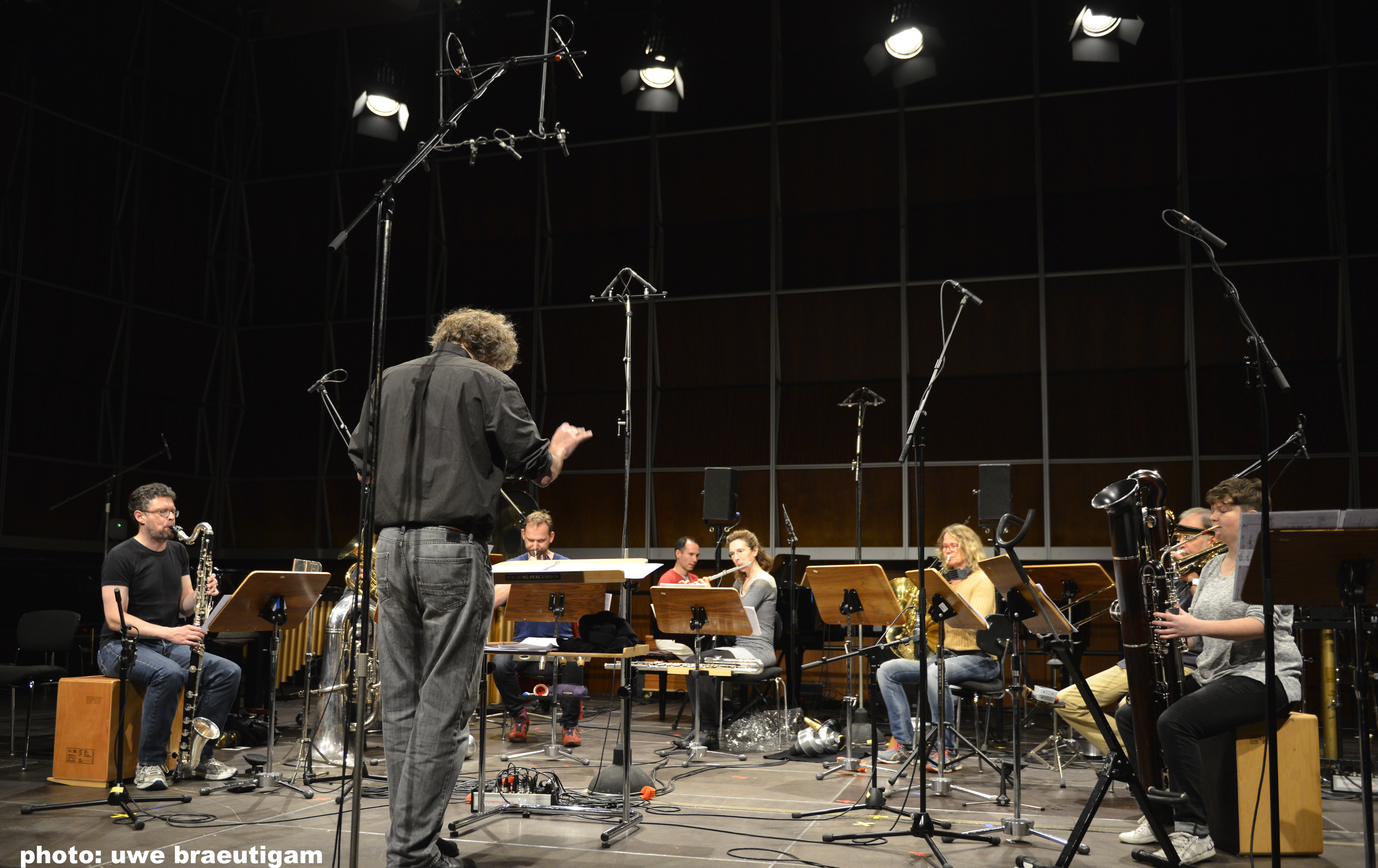
Ensemble Musikfabrik · Johannes Schöllhorn, conductor. Recorded on 11 November 2015 at the Deutschlandfunk Kammermusiksaal, Cologne, Germany.