Domenico Scarlatti & the accordion
Pairing a composer from the first half of the eighteenth century with the accordion may seem unusual, but it is not illogical: had an instrument like Dellarole’s been available in his day, the inquisitive, musically omnivorous Domenico might well have used it! Had he lived another twenty years, he would have witnessed the arrival in Europe in 1777 of a sheng, an Asian instrument regarded as a precursor of the accordion. It was sent from Beijing to Paris, to the minister of state Henri Bertin, by Joseph-Marie Amiot, a Jesuit missionary in China, a scholar of Mandarin and the author of numerous writings on Eastern music. Amiot had recognised the potential of the sheng’s construction, in which sound is produced by the vibration of a free reed.
Numerous inventors attempted to develop new instruments during the first decades of the nineteenth century. Among them was Cyrill Demian (1772–1847), an instrument maker of Armenian origin who, with his sons Carl and Guido, ran an organ and piano workshop at Mariahilfer Strasse 43 in Vienna. In May 1829, Demian patented an “Accordion”, an instrument that produced chords rather than individual notes. Similar instruments were subsequently patented in various countries under different names, including the concertina and bandoneon. In 1863, Paolo Soprani founded an accordion factory in Castelfidardo. Related forms of the name “Accordion” survive in many languages: Spanish acordeón, English accordion, German Akkordeon and French accordéon, while Italian uses fisarmonica.
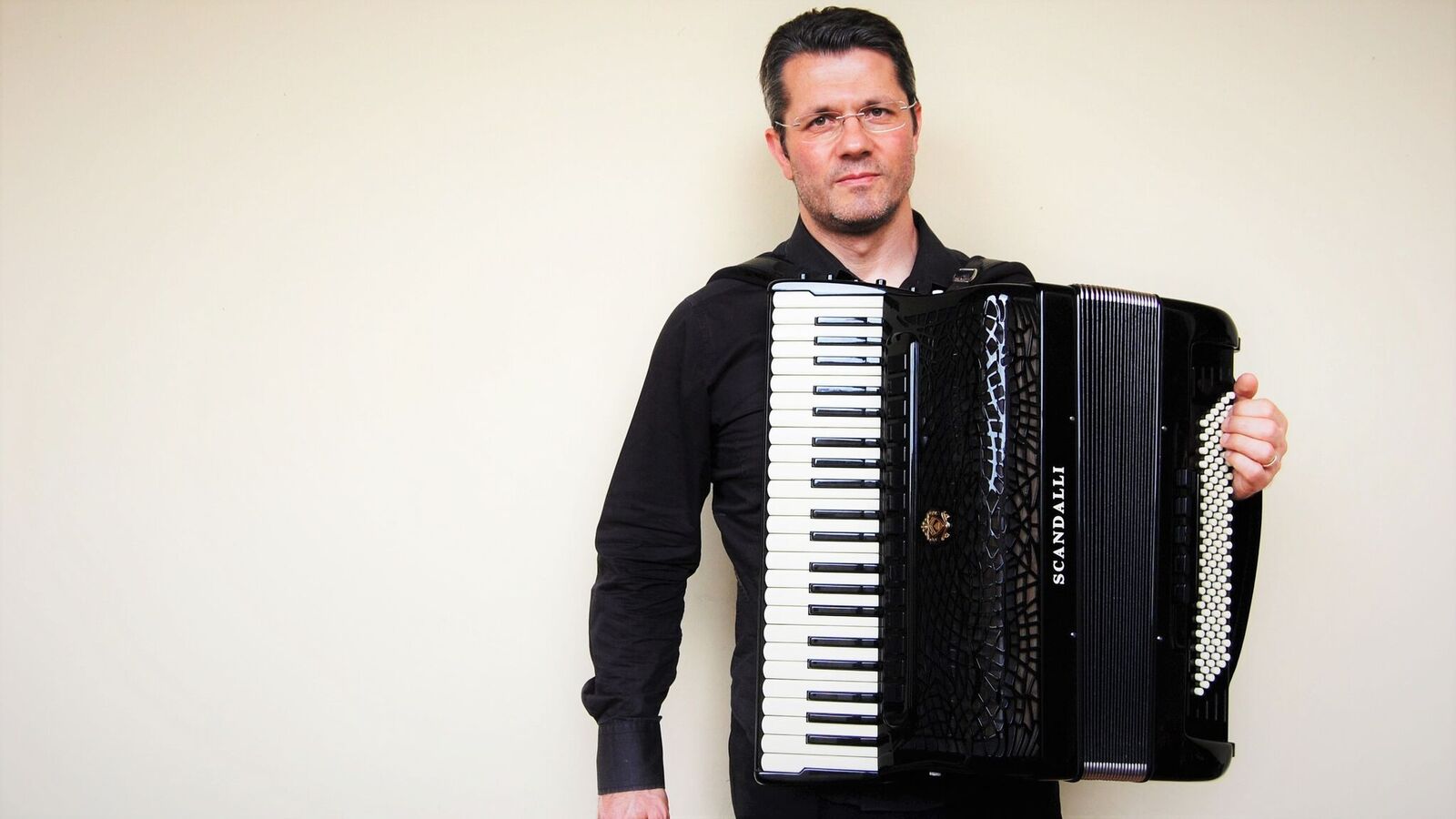
The accordion developed almost like a bespoke suit, tailored to individual performers. The instrument made for Dellarole for this recording is distinctive: its pitch of A = 415 Hz evokes a historical pitch widely used in performances of eighteenth-century music, while its tuning employs a keyboard temperament associated with Father Francesco Antonio Vallotti, an organist and theorist contemporary with Scarlatti and admired by Giuseppe Tartini. The listener will immediately hear how this instrument brings out the sound world of Scarlatti’s repertoire, in its timbre, expressive flexibility and treatment of musical time.
Choosing from Scarlatti’s corpus of sonatas is no simple matter: around six hundred works occupy ten volumes in the critical edition edited for Ricordi by Emilia Fadini. Dellarole has concentrated on the Essercizi, a fundamental document in the history of keyboard music, concluding with three pieces—K. 61/F. 9, K. 87/F. 48 and K. 397/F. 343—that differ in form and character.
Twelve of the recorded sonatas come from the thirty Essercizi per gravicembalo, whose title page identifies Don Domenico Scarlatti as a Knight of St James and teacher to the Prince and Princess of Asturias. The printed edition gives neither a place nor a date of publication, but scholars place it in London in 1738–39. It is a sumptuous volume, measuring 39.5 × 31.5 cm, in an unusually large oblong format for music publishing. Published by Adamo Scola and engraved by Benjamin Fortier, it includes a frontispiece by Jacopo Amigoni: an allegorical apotheosis of the dedicatees with the royal coat of arms. At the foot of the title page is a small but significant image of a Baroque harpsichord beneath the motto Curarum Levamen—relief from cares—surrounded by acanthus and myrtle, a decoration reminiscent of azulejos. The Essercizi were published during Scarlatti’s lifetime under his direct supervision; later publications did not enjoy the same personal oversight.
The volume contains two dedications. The first is addressed “To His Sacred Royal Majesty John V, the Just, King of Portugal, of the Algarve, of Brazil, etc., etc., etc.” and signed “your most humble servant domenico scarlatti”, with the composer’s name deliberately in lower case. Scarlatti praises the sovereign’s “great spirit”: John had made him a Knight of St James in 1738. In gratitude he offers “compositions born under Your Majesty’s highest auspices, in the service of your deservedly most fortunate daughter, the Princess of Asturias, and your most worthy royal brother, the Infante Don Antonio”. The teacher also celebrates his pupil Princess Maria Barbara’s accomplishments “in singing, playing and composition”.
The second dedication addresses the reader:
“Whether you are an amateur or a professional, do not expect profound learning in these compositions, but rather the ingenious play of art, to train you in facility at the harpsichord. Neither considerations of profit nor ambitions moved me to publish them, but obedience. Perhaps they will please you, and then I shall be more willing to obey further commands, to gratify you in an easier and more varied style. Therefore show yourself more sympathetic than critical, and you will increase your own enjoyment. To indicate the disposition of the hands, I advise you that D denotes the right and M the left. Live happily.”
Scarlatti knew that the London publication would serve more than his noble pupil: copies would travel beyond Lisbon to amateurs, music lovers and professional musicians united by the desire to read and study his sonatas. These few lines to the reader differ from other comparable prefaces, such as those accompanying François Couperin’s Ordres or Frescobaldi’s concise instructions. Scarlatti offers no advice about ornaments or detailed points of performance practice. Instead, he emphasises the purpose of the pieces: acquiring “facility at the harpsichord”, or complete command of the keyboard. The title Essercizi—Exercises—is therefore significant. It was an original choice for its time: Muzio Clementi’s Preludes and Exercises would not be published in London until 1790. Eighteenth-century musicians more commonly used the designation Toccate da studio, of which many manuscripts survive in the library of the Naples Conservatory. Francesco Durante’s well-known collection, printed in Naples in 1732, bears the title Sonate divise in Studi e divertimenti.
In the Essercizi, Scarlatti develops a personal, “bold” style, born less of academic conventions than of the ingenious play of art. His strength lies in inventio: the creative act itself, the genius of play.
Transferring these works to the accordion accentuates such qualities, offering a revitalised Scarlatti. Dellarole, shaped by Emilia Fadini’s teaching, gives the listener an interpretation surprisingly rich in effects and full of verve, while demonstrating a thorough knowledge of performance practice. His freely added ornaments, particularly in the repeats, are beautiful and tasteful. The sound of the accordion in Vallotti temperament can suggest a secular organ. Listen, for example, to Sonata III, Presto, in alla breve time (K. 3/F. 519): after its strange, fleeting opening, a sequence of imitative figures culminates in a long descending chromatic scale, while the hands exchange roles in a dialogue. These ascending and descending figures—anabasis, catabasis and passus duriusculus in rhetorical terminology—become comic exchanges rather than the emotionally charged gestures described in rhetorical treatises, as though Serpina and Uberto were on stage.
Vocal music is an essential point of reference in many of Scarlatti’s keyboard works. We should not forget two masterpieces perhaps less familiar than his keyboard output: the intermezzo La Dirindina and the Lettera amorosa, representing the comic and serious sides of the poetics of the affections. An interpretation that brings their theatrical qualities to life is therefore welcome, drawing on the instrument’s varied timbres, including its low register. For today’s listener, the accordion also suggests gestures and motifs from the folk tradition that forms part of the instrument’s history. This is evident in Sonata VI, Allegro, in F major (K. 6/F. 522), which reveals how personally Scarlatti draws on the interaction of different genres.
Each individual Essercizio is called a sonata. Formally, these works generally have two sections with repeats: from the home key, the music moves towards the fifth degree, with the first section ending on the dominant, before returning, more or less gradually, to the opening key at the end of the second section. Where the fugal principle prevails, the two-part design gives way to continuous development. This is the case in Sonata XXX—the sonatas are numbered consecutively in Roman numerals—the collection’s final work, known as the “Cat’s Fugue”. Its nickname evokes nineteenth-century illustrated editions and the unusual subject, which seems almost accidental, as if a kitten had walked across the keyboard.
The fugue crowns the Essercizi as a culmination of composition and performance, following a practice familiar among composers who were also teachers, Arcangelo Corelli being a notable example. It demonstrates a composer’s art while testing the performer’s specifically polyphonic virtuosity. Variations serve a similar purpose. This can be heard in the first of the three sonatas chosen to conclude the recording: a theme and variations that display the Neapolitan composer’s inventiveness, especially in the final sections, with their profusion of repeated notes. The second, without a tempo indication, is pervaded by profound melancholy. Its emotionally intense, almost meditative character is suggested also by its key of B minor, the key of Bach’s great Mass.
A joyful minuet, Allegro, in D major releases the tension. Far removed from the atmosphere of the court, it comes closer to the folk dances that inspired Scarlatti. Throughout eighteenth-century music, the grave, tragic, poignant, serious, melancholy and terrible coexist with, and are transcended through, the elegance of lightness.
Album Notes by Pinuccia Carrer. English text revised from the original booklet and the author’s Italian text.
Recording credits
Giorgio Dellarole, accordion. Instrument: a custom Scandalli accordion in Vallotti temperament, A = 415 Hz. Recorded on 26 and 27 January 2018 in the Baroque Hall, SMC Records, Ivrea, Italy. Sound engineering, editing and mastering: Mario Bertodo and Renato Campaiola. Inside photograph: Gianluca D’Amico. Production, design and art direction: Da Vinci Publishing. With the support of S.P.L.M. © and ℗ OMK–Da Vinci Classics. DDD. Manufactured in Japan.
Special thanks to Emilia Fadini for her valuable advice and support and to Pinuccia Carrer for her album notes, which enriched the project.
This album is dedicated to Alessandra and Daniele; without their patience, its realisation would have been impossible.